


Think
See every new challenge through competing lenses.
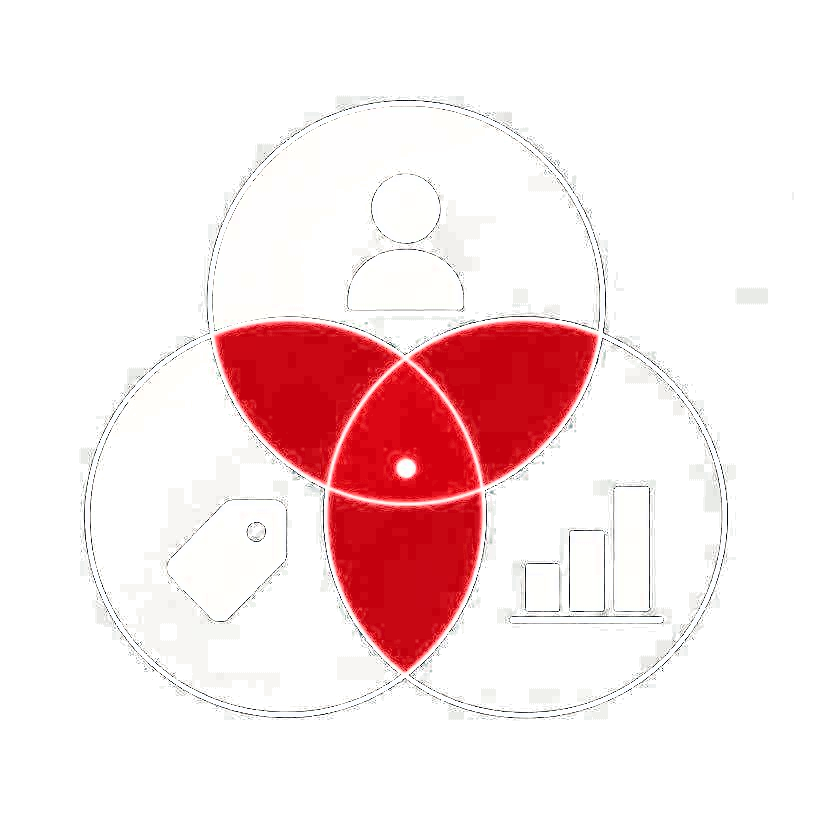
Strategy · Audience · Lenses

A complete marketing operating system
Be a marketing hero. Stop second-guessing your next move. Build sharper strategies, stronger campaigns, and marketing work you're proud to put your name on.
Sharper decisions. Better work. More confidence.

The whole path, in view
Most marketers mistake brainstorming ideas, reusing yesterday’s winning tactics, and adding a few strategic glimpses for a strategy. It isn’t. Serious marketing is better than that.
See every new challenge through competing lenses.
Strategy · Audience · Lenses
Carry the strategy into your deliverables.

Offer · Funnel · Campaigns · Content
Let evidence decide your next decision.

Experiments · Evidence · Reports
The secret sauce
Marketing theory, behavioural science, proven frameworks and competing expert perspectives, all built into one guided system.
Whether you're starting your first marketing project or have years of experience, MarketingMindOS takes you through the process, step by step. You always know what to consider, why it matters and what comes next.
You bring
A product to launch, an audience to reach, a decision to make.
The system brings
Expert thinking, organised into a clear path from the first question to the finished work.
You create
Work you understand, can explain and can build on.
All the depth. None of the intimidation.
The marketing workspace
Your strategy, campaigns, experiments and learnings belong to the same system. The context stays with the work, so you can focus on what comes next.
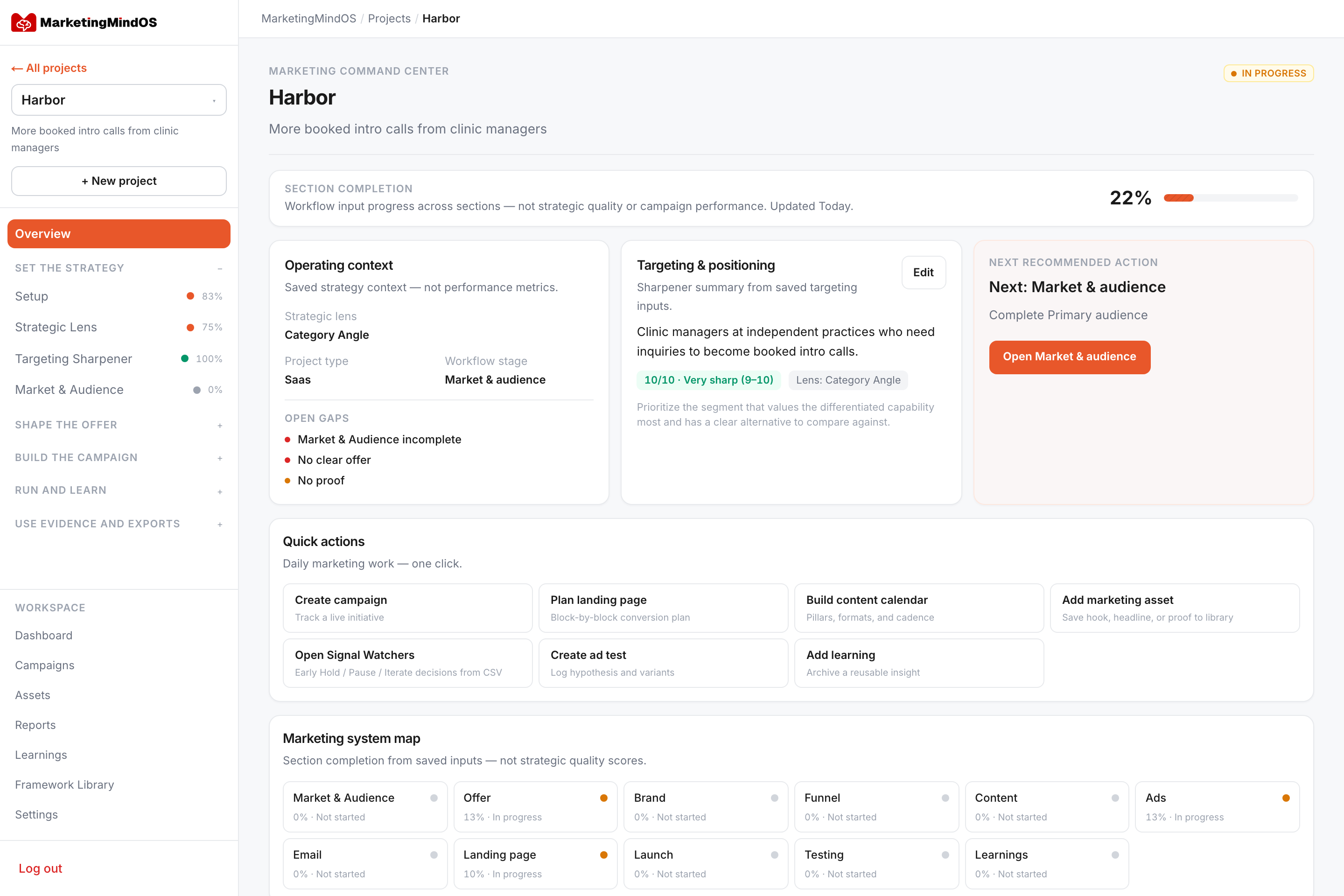
Bring advertising, analytics and search performance into the decisions you make with MarketingMindOS.
More than one strategic read
See your challenge through competing expert lenses, uncover blind spots, and discover possibilities a single answer might miss.
The Challenge
Category Angle
Desire & Friction
Creative opportunityTwo perspectives. More possibilities.
Strategy that moves with your work
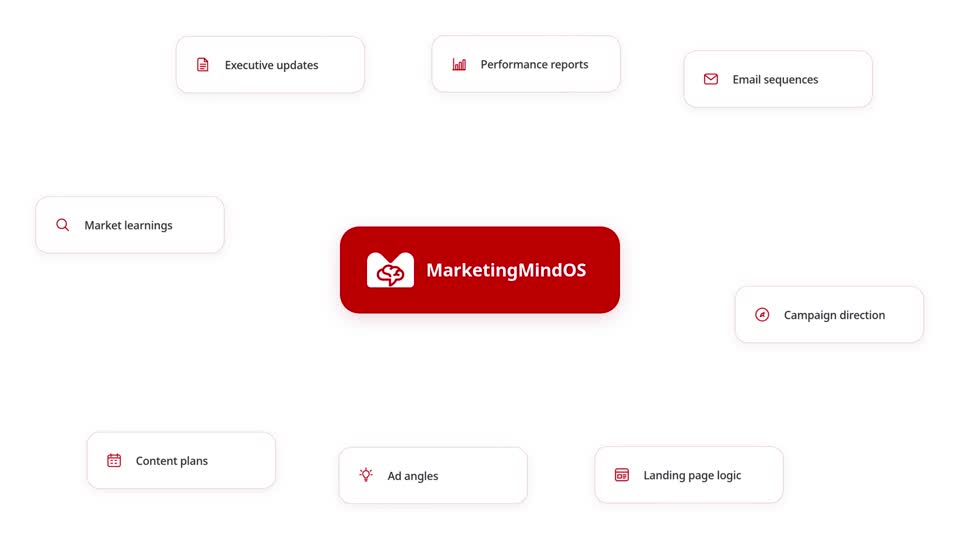
Most strategies break during execution. With MarketingMindOS at the center, your audience, offer, brand direction, and evidence stay in orbit around the work you create.
Test with a reason
Start with a hypothesis. Review what the available evidence can and cannot support. Then decide whether to hold, pause, iterate, investigate, or keep collecting data.
The question
Which message will get more people interested?
Same product. Two different ways to communicate its value.
Go beyond these two examples. Explore 13 strategic perspectives built into MarketingMindOS.
What the customer gains.
Reducing uncertainty before a decision.
From signals to a point of view
Go beyond dashboards and activity summaries. Show what changed, explain what matters, and bring a clear, evidence-backed point of view to every client meeting, team review, or leadership conversation.
Marketing Review
Campaign performance · Illustrative example
More traffic. More leads. But are we attracting the right customers?
Activity is improving, but lead quality needs investigation before increasing investment.
What changed
What this means
Higher activity alone doesn’t establish stronger commercial performance.
Recommended next move
Review lead quality by campaign before reallocating budget.
Built around the work you carry
Whether you are building a company, starting your career, growing into bigger decisions, serving clients, or leading a team, the system keeps strategy and evidence connected to the work.
Before you spend on agencies, hires, or campaigns, understand what effective marketing actually requires. Experience the system, sharpen your offer, and make your first marketing investments with more confidence.
See how a first project comes togetherBuild the foundations of serious marketing from day one. Learn to think strategically, develop campaigns, understand buyer behavior, and make decisions you can explain.
Start with strategic thinkingAlready working in marketing? Take your skills and your career further. Strengthen your strategic judgment, expand what you can deliver, and become the marketer trusted with bigger decisions.
See everything the system coversBring a stronger methodology to every client engagement. Keep strategy, execution, assets, experiments, and learning connected, and deliver work that shows real professional depth.
See how client work stays connectedBring strategy, performance intelligence, reporting, planning, and team decisions into one operating view. Make stronger decisions and communicate them with authority.
See leadership reportingYour next level
Where are you operating from today? Pick the closest match to see the plan the current public site recommends.
Recommended plan
Recommended plan: Pro
€49 / month
Plan, execute, and learn from campaigns with more consistency and reusable memory.
Start with Pro →Compare all four plans